
News
Demonstrating GDPR Compliance Through Europrivacy Certification: Structuring Trust in Health Data

🌐 Introduction
In today’s data-driven healthcare ecosystem, trust is no longer a soft value. It is a regulatory, ethical, and operational necessity. The increasing use of sensitive health data in Clinical Research, digital health solutions, and AI-driven diagnostics has placed organizations under growing scrutiny. On the one hand, there is growing regulatory oversight, and on the other, increased expectations from data subjects.
While the GDPR established a robust legal framework for personal data protection in the European Union, it does not, by itself, offer a standardized, operational model for demonstrating compliance consistently, verifiably, and at scale across complex data processing ecosystems.
This is where Europrivacy, the European Data Protection Seal, emerges as a significant tool for bridging the gap between regulatory requirements and operational trust by transforming Data Protection from a regulatory obligation into a structured, auditable, and externally validated trust framework.
🛡️ GDPR: A strong foundation with operational challenges
The GDPR establishes a comprehensive framework for the protection of the personal data of EU residents. It is particularly stringent when it comes to special categories of data (Art. 9), including health data, which require enhanced safeguards and appropriate legal bases for processing.
GDPR principles, such as lawfulness, fairness and transparency, purpose limitation, data minimization, integrity and confidentiality, and accountability, provide a solid foundation for protecting individuals’ rights and structuring data processing activities.
In practice, on the other hand, organizations face multiple challenges in implementation. In particular, the Health Data environment is a highly fragmented and multi-layered ecosystem involving sector-specific laws, Data Protection laws, as well as local requirements in each EU country. It also involves multiple stakeholders that may act in different capacities, such as controller, joint controller, or processor, thereby adding complexity to the allocation of responsibilities and alignment of compliance obligations.
The complexity of the landscape results in a high degree of variability in the interpretation and application of controls across organizations and adds further challenges to standardizing practices across global operations. Ensuring consistency in documentation and data governance can prove quite difficult in this complex environment.
A critical gap emerges where organizations that may be compliant in theory can struggle to demonstrate that compliance in a standardized and trusted way.
🔎 Europrivacy: Demonstrable trust
To address the growing gap between regulatory compliance and its practical demonstration, the GDPR provides for certification mechanisms as a structured means of demonstrating conformity with Data Protection requirements. In this context, the Europrivacy certification scheme is the first official GDPR certification mechanism approved under Art. 42. It provides a structured methodology to assess GDPR compliance, serves as a certification scheme applicable across multiple sectors, and provides recognition of compliance aligned with EDPB guidelines.
The Europrivacy certification scheme adopts an evidence-based approach based on a clear and comprehensive definition of assessment criteria aligned with GDPR requirements. It also requires complete documentation and verifiable evidence of compliance. Certification is provided by independent and accredited certification bodies.
Thus, compliance, which is commonly considered an internal exercise, becomes a fully transparent and auditable process available to external stakeholders.
🧬 Europrivacy for eHealth
The health sector involves the processing of highly sensitive data, the retention of data for long periods to comply with legal requirements, and the constant reuse of data. The combination of regulatory fragmentation, technological innovation, and ethical expectations adds another layer of complexity to the compliance framework.
Processing health data usually requires interactions with different jurisdictions and cross-border transfers outside the EU. Aligning the requirements of multiple Data Protection laws can prove quite challenging at times.
The Europrivacy certification scheme provides a European benchmark that structures compliance in a way that facilitates comparability and understanding across different jurisdictions and supports transfer impact assessments and international collaborations. While it does not fully replace non-EU frameworks, the Europrivacy certification can act as a reference point for high Data Protection standards in global operations.
It also takes an approach that includes sector-specific requirements in the establishment of the compliance framework.
The eHealth sector is intricately related to data-driven innovation. It relies on continuous data collection, large-scale data aggregation, and the use of AI and machine learning models. In this fast-evolving environment, it is very challenging to provide fully transparent information to data subjects, ensure the collection of informed consent, ensure data minimization, and efficiently govern the secondary use of data. By adopting the Europrivacy approach, it is easier to embed privacy by design and accountability principles into digital solutions. The Europrivacy certification scheme also facilitates the governance of the data lifecycle and ensures that innovation is supported by demonstrable safeguards.
As the EDPB noted in its Opinion approving the Europrivacy certification criteria, certifications add value to controllers and processors by helping them implement standardized and specified organizational and technical measures to facilitate and enhance the compliance of data processing activities with the GDPR. The Europrivacy certification is a valuable tool for organizations operating at the intersection of healthcare, technology, and global operations. It offers a credible, interoperable, and scalable demonstration of compliance that aligns GDPR requirements with the reality of health data processing.
⚙️ Implementation steps
The Europrivacy certification scheme has a clear and defined implementation process.
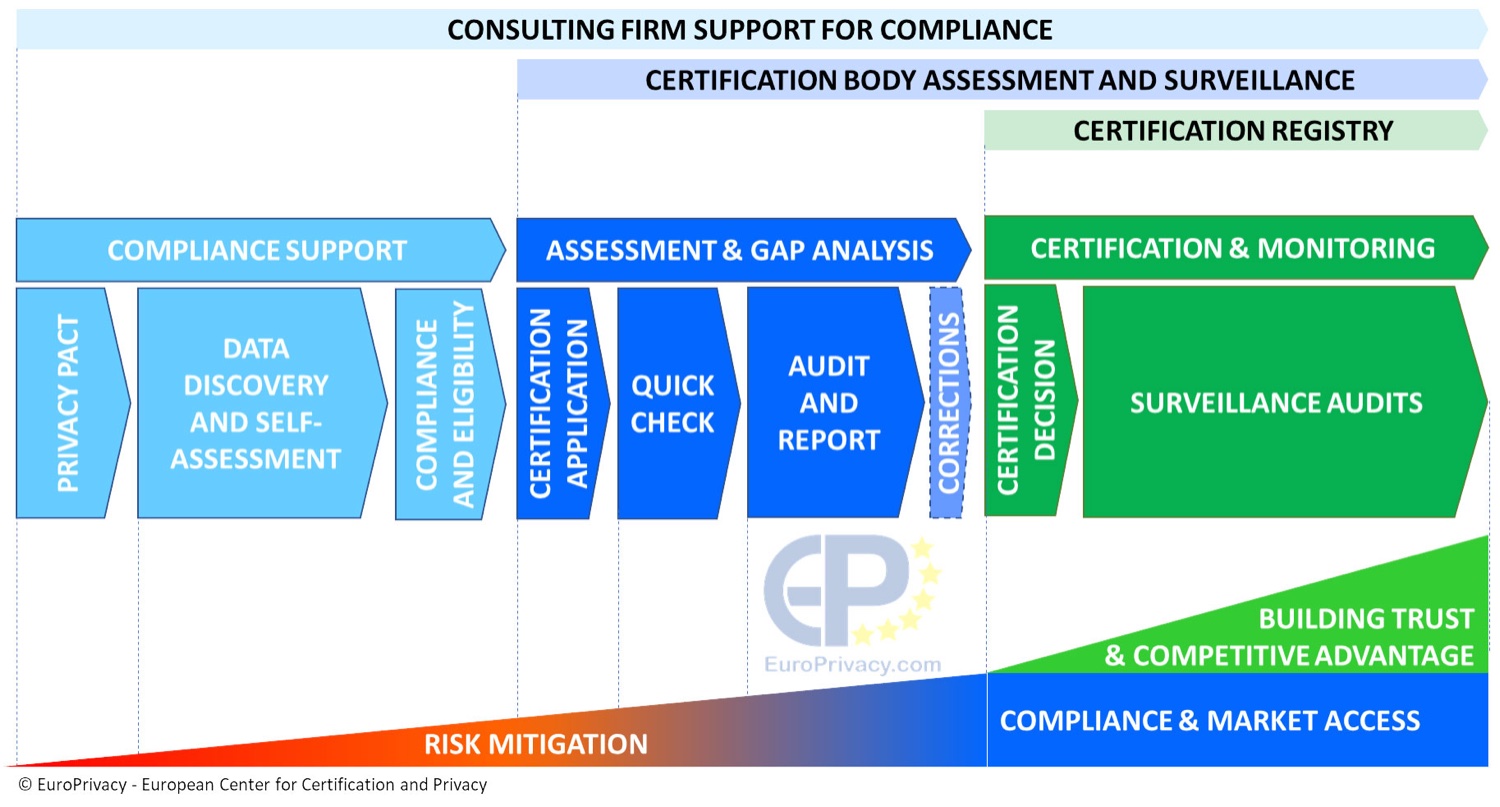
© EuroPrivacy - European Center for Certification and Privacy
Europrivacy is not a one-time effort. It is a continuous improvement process requiring regular updates to documentation, risk assessments, and ongoing compliance monitoring.
📈 Strategic benefits
One of the key limitations of GDPR compliance is its lack of visibility. By offering a recognized certification based on a common reference framework that is well understood across the EU, the Europrivacy certification provides a tangible proof point visible to partners, clients, as well as regulators. It establishes a trusted basis for third-party assurance and reduces the need for repeated assessments.
The Europrivacy certification also offers a harmonized framework across complex ecosystems involving multiple stakeholders bound by different jurisdictions by standardizing how requirements are interpreted and assessed, supporting consistency across multi-country operations, and aligning expectations between stakeholders.
By enabling organizations to prove their compliance through a recognized and independent framework, the Europrivacy certification strengthens confidence among regulators, partners, and data subjects alike.
The Europrivacy certification also ensures the implementation of a structured methodology that enhances internal governance by clarifying roles and responsibilities. It implements a robust system of documented evidence that facilitates traceability. It also involves a risk-based approach to better anticipate risks, improve incident response, and provide consistent decision-making within the organization.
🔐 Conclusion
The Europrivacy certification provides a structured, certifiable approach to Data Protection and enables organizations to move from compliance to demonstrable trust.
In a complex ecosystem such as the health sector, the Europrivacy certification can prove to be a tool of choice for navigating legal requirements and building a robust compliance system standardized across an organization.
The Europrivacy certification offers a structured and scalable framework that aligns with Data Protection expectations and serves as a foundation for future regulatory requirements. This enables compliance with current obligations while also providing the means to adapt efficiently to future developments in the Health Data landscape.
“Trust, but verify” is the essence of Data Protection in the health sector. The Europrivacy certification is what makes that verification possible.
Author: Aymen Ouerghi